Almost Everything About Nail Clippers and Scissors


Thanks to tools such as nippers, pliers, forceps, and scissors, today's cosmetology, podiatry, dentistry, and surgery can achieve success in the services provided by these fields.There is only one condition—these tools must be of the highest quality.Without this, every procedure would fail.
In today's world, retailers and stores that supply the industries mentioned above can offer an endless variety of shapes and types of tools.Shoppers, on the other hand, are in for a real “treat,” finding everything they could possibly want, with plenty of options to choose from.
Exactly, but when you were faced with choosing this kind of equipment, didn't you ask yourself if it was really the right choice??
What should you really look for when buying nail clippers or scissors??
Here are a few helpful tips:
- Buy nail clippers and scissors only at specialty stores that carry supplies for your field.Retail stores and supermarkets do not offer the highest quality of such tools.This is the result of massive wholesale orders, where, of course, not everything is necessarily defective or non-functional, but mass production on a tight budget often leads to haste, which in turn results in manufacturing and technical errors..The quality of the steel also plays a very important role here.Steel that is too soft dulls quickly and is prone to deformation.
- Ask the seller for the certificate of approval for the European market.
- Make sure the tools are made of the right materials.They are usually marked directly on the nippers or scissors.The seller should have the necessary information regarding ISO certifications pertaining to steel quality and manufacturing technology.
- See what it says on the tools.It's a good idea for tools to also have the logo or name of the company responsible for the product's design and quality engraved on them.
- Ask the salesperson.At specialty stores that focus on specific product lines, you'll get expert advice, accurate product descriptions, and even after-sales service.
- Choose a tool size that fits your hand so you can hold it securely during the procedure.
- If possible, check out the tool you're planning to buy in person at the store.
This raises another question— how to check the quality and functionality of nail clippers and scissors?
Depending on their profession, everyone has heard about how to test this type of equipment.Maybe it also taught him, through experience, what he replaces so often and why.
In any case, when it comes to nail clippers:
- In addition to their size, take a look at how they're constructed at the joint—that is, the middle section where the "Mother" and "Father" connect (more on this later).According to experts, the best nippers are those made using the blacksmithing method.They are durable and accurate.They also don't spread out to the sides after a while.
- The nippers need to move smoothly so they don't cause problems or get stuck.
- Look at them against the light and squeeze the blades together slightly, bringing them into what is known as "first contact.".It is very important that the edges at the tips fit together perfectly, and that no two tips are longer than the other.
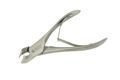
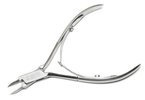
- Cuticle nippers, side nippers for trimming, and ingrown toenail nippers.
Along the blade, there should be a very subtle gap running from the tip downward—not the other way around.When there is no space between them and the blades come together—for example, lying flush against each other—the blade will quickly become dull..Only by applying more pressure should the blades come together.It works like a spring that snaps back into place when released.
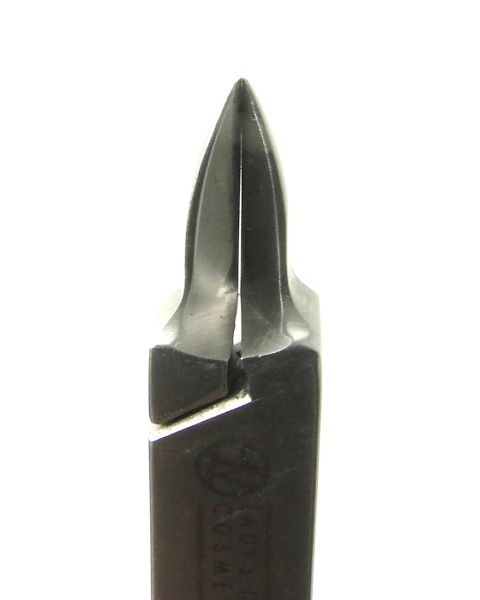
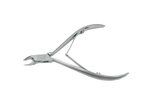
- Front-end nippers and snip pliers.
This type of clippers, in turn, must have blades that align perfectly with one another, without any so-called gap..It is very important that the two tips of the blade are perfectly aligned with each other and do not stick out from one another.Otherwise, it is very easy to injure the patient. - Combination nippers, with round jaws, dolphin-style, etc..
Above all, this type should match the size and shape.The jaws must meet precisely at the tip and should have a good grip. - Needle Holders.
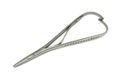
Here, in turn, attention should be paid to the teeth and bite force.The teeth should be cut at an angle so that, when a thin wire is squeezed, they provide a secure grip.You can try this by gently clamping a piece of smooth orthonyxian wire or a sewing pin between the jaws of the needle holder, and then pulling the wire in the opposite direction.
The needle gripper must have a flexible gripping section and special locking steps.The part that rests in your hands (also known as the wing) must be made of the appropriate spring steel.It is responsible for the clamping force and for safety during the procedure.The steps, in turn, must be cut at an angle to securely hold the clamped object.The wings must overlap exactly.They must not splay apart, because placing the curved wings over the teeth could cause the gripper to unlock.A needle catcher is your third hand, so it has to be of the highest quality. - Specialized clippers for cutting items such as orthonyxial wire should have a hardened cutting edge.This material is much more durable and lasts much longer than nippers with an unhardened blade.The hardened cutting edge on the pliers has a slightly different metal color, and that's how you can tell if the blade is hardened or not.
- How to check if nail clippers or scissors are sharp?
The blade should not be too flat or too thin, and the grind must have what is known as a profile..The perfect cut must be made in a single, confident motion across the entire surface being cut.
Take a piece of stiff paper (not flexible), such as an envelope, and fold it in half.Then try making a cut along the fold of the envelope.The cut must be straight and precise, and the so-called "finish" must be done right the first time.. - If you want to sterilize your nail clippers, keep in mind that the autoclave is subject to high temperatures and steam pressure.High-gloss, colored, or nickel-plated nail clippers are generally not suitable for sterilization.Sometimes the top layer of nickel chips off and causes cuts on the hands.
- It's better to choose uncoated nail clippers.
- If you want a glossy finish, choose extensions that have been given a glossy finish using the so-called "brushing" method..Comb-toothed clippers and forceps maintain their appearance even after multiple sterilization cycles.
- Nail clippers with a matte finish can be coated with matte varnishes or given a matte finish through sandblasting or by spraying with corundum..If you want matte nail clippers, go with the second pair, but make sure there aren't any small marks or indentations on them.That is where microscopic contaminants and germs can accumulate.
- Nail clippers should have a double spring—they're more functional.Scissors with a single spring rub their tips against the inside of the blade and become noisier.Also, you have to be careful to always grip the clippers in the same spot with the same grip, because changing it can result in a loss of feel while cutting..
Nail scissors are different from scissors used to cut bandages or from hair-cutting scissors.
When it comes to hairdressing scissors, the most important factors are size and the blade.Hairdressing scissors must be able to cut a single, very fine strand of hair at the tip in a single stroke.The exception is the degażówka.
Because hair-cutting scissors must be disinfected after each use on a single client, they should not be coated or painted to prevent any damage..In addition, if the client’s scalp is cut and the metal comes into contact with blood, these scissors must be sterilized in an autoclave before they can be reused..That's why the best scissors are uncolored and made using the comb-cutting method.The silicone protective rings inside the handle can be removed for disinfection and/or sterilization.
Nail clippers come in various shapes.From Curved to Straight.As a rule, they have two equal blades, just like nail clippers.There are also scissors with one sharp blade and one serrated blade.This second, serrated blade is responsible for sharpening the other blade, which means the scissors do not need to be sharpened.
How to Sharpen Nail Clippers and Scissors?
This is an extremely difficult matter.Sharpening the dull blades of pliers until they are as sharp as when they were new often borders on a “miracle.”.Often, even the skilled hand of a good locksmith isn't enough to succeed.This also applies to scissors.Sometimes it is possible to resharpen them, but the number of cuts that can be made with resharpened nippers or scissors is already significantly limited.So, in this case, it's more a matter of luck than a well-honed sharpening technique.
To explain this problem, we need to look at the manufacturing process for pliers or scissors.Nail clippers and scissors are not sharpened by machine.None of the pencil sharpeners available on the market measure up.So don't buy things like that—you'll just waste your money and won't get any positive results..
Nippers or scissors that have come into contact with a hard surface, such as a floor, after falling onto it from above—whether onto the blade or the side of the blade—will never be sharp again, and any attempt to sharpen them will fail.
The highest-quality steel ensures a perfect cut and comfortable use, but if the tool is dropped, it’s a disaster for its owner.
How to Care for Nail Clippers or Scissors?
Once you've chosen the right tools for yourself, make sure they last as long as possible.It's up to you whether that happens.
- Use your tools only for their intended purposes.Don't use, for example, cuticle nippers to quickly cut a very thin piece of wire just because they happen to be within reach and will do exactly the same thing as wire cutters..Just one stunt like that, and it's all over.In that case, the cuticle nippers won't trim the cuticles properly and won't serve their purpose..
- Nail clippers and scissors must be oiled.
Especially those that go on to be sterilized after disinfection.During this process, the material from which they are made is put to the test.The ductility of steel affects the loss of lubricant, such as olive oil.When the pliers lose their lubrication, they become harder to move, and it becomes more difficult to work with them.
Our advice. After thoroughly drying the instruments removed from the autoclave or ultrasonic cleaner, spread them out as much as possible, keeping the blades apart from one another.Apply one drop of olive oil to the center where “Mother and Father” are moving, and wait 3–5 seconds.Then start gently squeezing the jaws until you feel a slight resistance when closing and opening the jaws of the pliers or scissors.This procedure should be performed at least every fifth sterilization.
There are two types of olive oil.One (the cheaper one) can withstand temperatures up to 100–140 degrees Celsius, while the other can withstand temperatures over 200 degrees.The first one—when the instrument is sterilized at a higher temperature—may leave a rusty film.Although it looks like rust, it is not actually rust but a tarnish on the material, and it can be removed with a special eraser for polishing stainless steel or, for example, door handles.. - Disinfection plays a very important role.The disinfection process must not be too long or too short.Disinfection that is too short is not disinfection, and exceeding the disinfection time leads to damage to thin steel, in this case the blades..
After disinfecting the tool, rinse it in clean water (preferably distilled water).
Use distilled water to dilute concentrates as well.Tap water may contain m.in.calcium, which, when it reacts with certain disinfectants, can lead to the formation of deposits and yellow or white stains.These must be removed immediately. - It is highly recommended to store nail clippers and scissors in a dry place in separate containers.Tools coming into contact with one another can have negative consequences.A good way to do this is to keep the tools in sterilization bags or in separate pockets in the drawer.
- If you need to store your nail clippers side by side in your drawer, you can put the silicone caps—which the manufacturer provides when you buy a new pair—over the blades.
Now, a little bit about “Mother and Father” and the production process.
Did you know that nail clippers are both mother and father??
It may seem funny, but manufacturers of nippers—especially forged ones—use only these terms: “mother blade” or “father blade.”.
Has anyone ever wondered how to assemble a pair of nippers??
It's an incredibly precise, almost watchmaker-like piece of work.Not only must they be assembled flawlessly, but their blades must also have the ideal profile, and the cut must be perfect and precise. 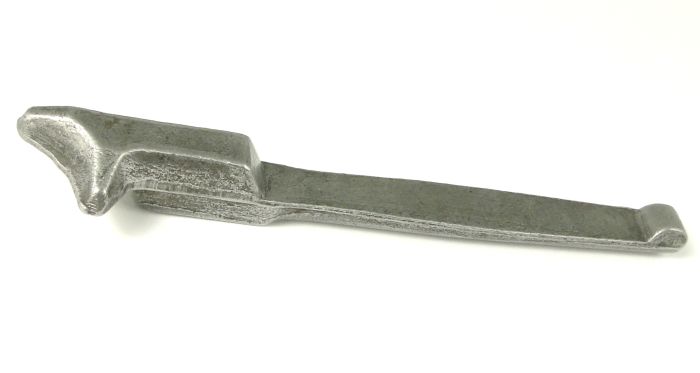 The photo on the right shows one of the two parts in its raw state.
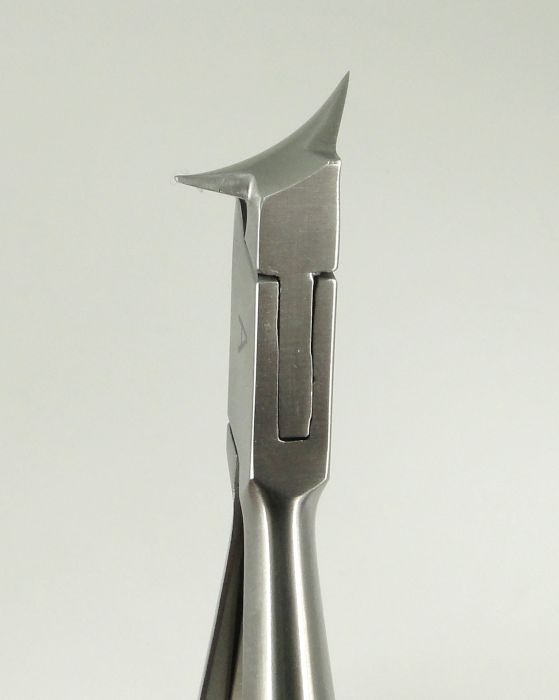 Ready-to-use cuticle nippers and ingrown toenail clippers.
Most good nail clippers are handmade.The blacksmith's method involves heating the Mother until she is red-hot so that a hole can be made in the right place for the Father to pass through..The joined Mother and Father are patted and shaped.It all happens on hot metal.The parts are heat-treated multiple times.The right quality of steel plays a huge role here.Each part is machined with extreme precision.As much as 95% of the production process is done by hand.
How a Blade Is Made?
Every master blade-sharpener has his own unique sharpening style.When performing this action, the single motion that results in sharpening can take various forms.Therefore, in order to resharpen the shears, you need to know the sharpening profile, and only the master who made the shears knows that profile.Any modification or sharpening performed in a workshop or even at a locksmith’s shop carries the risk of damaging the blade.Metal collection through friction leads to metal collection.Sharpening them yourself isn't necessarily a bad thing or even impossible, but whether the clippers you send in to be resharpened will perform just as well as they did when they were new is another matter.
It becomes impossible to sharpen the clippers once they fall onto a hard surface.Even the slightest bend in the metal is enough, and even though they look just like they did before they fell, they won't be able to cut your nails or cuticles perfectly anymore.
So it's best not to send your pruning shears or scissors in to be sharpened if they've hit hard ground beforehand.A good professional will be able to tell whether they've fallen off or not anyway, and you'll have to pay for the locksmith's work regardless (costs, if any).(including shipments).
Is that all the information about nail clippers and scissors??
Probably not, but if you've learned something more than you knew before reading this article, then our mission has been a success.
We hope you enjoy working with the tools you've chosen.May they serve you well for a long time.
Author of the article – Marek Cyrulik
12.10.2012