
Almost Everything About Nail Tips



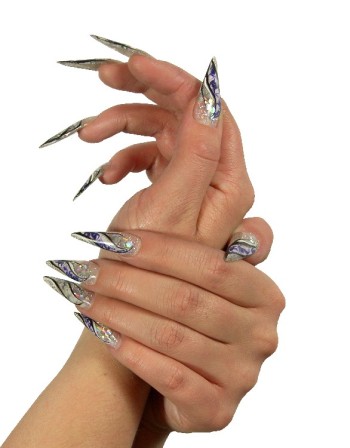
You've probably tried all kinds of nail tips before, but do you know everything there is to know about them??Do you know what materials they're made of??Why Do Nail Tips Break, and How to Fit Them to Your Nails?
In this article, we'll try to explain the most important things you need to know about nail tips.
Everyone knows that there are cheap and expensive nail tips, or bad and good ones.Not everyone, however, stops to wonder why this is the case.It cannot be said with certainty that cheap nail tips are useless.Very often, their price is closely linked to the quality of the materials, molds, or machinery used in their production.

High-quality nail tips are flexible, easy to work with, and, most importantly, they don't break.The quickest way to check this is to bend the tip sideways from the inside..The tip shouldn't break in that case; it might just leave a white line, which is natural in this situation.Of course, if you bend the same nail tip in the opposite, outward direction, it’s bound to break.
To produce very high-quality nail tips, manufacturers use the best plastic materials.There's a lot that could be said about the production itself, but let's focus only on the most important aspects of this topic.
Acrylonitrile-butadiene-styrene (ABS) or Polyflex (polypropylene/ethylene-propylene dimer) is injected into the appropriate molds..The proper proportion of materials used—such as stabilizers, antistatic agents, fillers, plasticizers, dyes, pigments, and even flame retardants—is of the utmost importance when it comes to the quality of the tips.This is where the key to the secrets of making perfect nail tips lies.A manufacturer who knows they have the best product guards their secrets closely, while competitors try to "put together" something similar—but they don't always succeed..That's exactly where good and bad tips come from.
The most common types of nail tips are: natural (milky), clear, white, colored, and decorated.
Milk-colored tips are most often produced with a traditional, larger pocket.They then have greater grip and, as a result, greater resistance to strong impacts.For very short nails, there are also tips with a small pocket available.Milk tips are used in almost all nail extension methods.
Clear nail tips are best suited for decorations.Keep in mind that, due to their transparency, they are slightly harder than milky tips, which is a result of manufacturing capabilities..
White and Colored Nail Tips are applied to the tips of the nails.They have only a small pocket, or none at all.White French tips also come in a variety of smile lines, and a major advantage is how quickly you can work with them.
Nail tips come in various shapes: traditional, rectangular, claw-shaped, dagger-shaped, tapered at the sides, or in various tunnel shapes.
Choose flexible nail tips with a strong base and a thin pocket.A nail tip that is too thick will be difficult to work with and may break more easily, while a thin nail tip may be too fragile..A thinner pocket will make it easier for you to blend the tip into the natural nail plate.However, in the case of white nail tips, the tip cannot be too thin, so that the color of the nail doesn't show through it.
Most nail technicians have probably already encountered the problem of tips breaking.Below are a few important reasons why nail tips break, along with some advice:
- Choosing Tips. Try to perfectly match the shape and size of the nail tips to your previously prepared natural nails.If you can't get a perfect fit, remember that it's better to choose a tip that's slightly larger than one that's too small.
- Applying a nail tip. Apply the adhesive to the nail tips so that there isn't too much or too little..Apply the nail tip to a very lightly buffed natural nail, starting by pressing the edge of the pocket against the nail at an angle of approx..45 degrees, then gently press it against the tile.Be sure to prevent air from getting trapped under the tip while applying it..After applying the tip, don't try to shape it any further just yet.If you're dealing with a problematic nail plate, adjust the tip before gluing it on—for example, by making a small cut or a small "V"-shaped notch..For a severely deformed plate, it's better to suggest a method using a template.
- Longitudinal cracks are caused by improper application of an acid primer.If methacrylic acid, which is the main component of the primer in question, comes into contact with the surface of the nail tip, it will cause the resin to harden, which in turn increases its brittleness..
- Also, be careful with other chemicals.If the nail cleaner contains too much alcohol, or if a cotton swab soaked in it is left on the nail tip for too long and the liquid doesn’t have time to evaporate, this can also cause increased brittleness..
- In addition, excessive filing of the nail bed —that is, the transition between the tip and the natural nail—can lead to the tips breaking later on.It's best to use a white block to mattify nail tips.
- Cracks on the free edge may be caused by using a worn-out or defective blade in the nail tip cutter.If you notice that the edges of the tip are curving or becoming uneven as you trim it, or if you find yourself having to use more and more force to do so, replace the guillotine blade..
- Other cracks on the nails can also be caused by: using unsuitable acrylic or gel products, applying them in the wrong order, skipping a step in a given method, or mixing products from different brands.
- A Few More Tips. Don't store your nail tips in a hot or very sunny place, because they may warp or even change color..Protect them from intense chemical fumes.It's best to keep them in a container in a cabinet and take them out only to find the right size for your nails.

Degreaser
Ensures optimal adhesion between the tip and the modeling material.
The sheer number of types and varieties of nail tips available on the market can be overwhelming, which is why LNC offers you only carefully selected, tried-and-true nail tips of the highest quality.The wide range of tips available from LNC allows you to make the right choice.
The best option is, of course, a training session where you can ask questions about anything, try things out, and practice.Read about LNC training courses