Almost Everything You Need to Know About Nail Files


Have you ever wondered what nail files are made of??Have you ever held all kinds of nail files in your hands??Or maybe it would be a good idea to at least familiarize yourself with the theoretical aspects of this topic.Below is a description of nearly all types of nail files, including their characteristics, disadvantages, advantages, and uses.
Types of nail files:
Paper Nail Files – these are the most popular and least expensive nail files.They continue to be a hit among manicurists.You can use them both for filing natural nails and for other nail extension techniques.They are available in the following colors: white, black, zebra, sand, green, and many others.
The name "paper files" comes from the fact that the outer, abrasive layer of the file consists of a special type of paper to which various types of metal filings are adhered..
They have a significant impact on the quality of work and the service life of files.The following materials are used as abrasive media in the manufacture of paper files:
- Scandinavian wood shavings (they're very durable),
- aluminum oxide aggregate,
- silicon carbide,
- Mylar,
- zinc stearate,
- or, for example, a self-sharpening zirconium coating.
All of these shavings are coated with a strong adhesive in the appropriate color and, together with the paper, are glued or pressed onto a special plate called the core.The cores are made of wood, plastic, Teflon, and sponge.Combining different cores affects the hardness and flexibility of the file, giving you a variety of manual and technical options with the file you choose. Manufacturers use different core colors to make the files easier to identify.Unfortunately, it often turns out that even when the core and paper are the same color, they aren't always of the same quality.Each file of the same color can be manufactured in three grades, each of which may have a different strength and price.To see for yourself how good the file is, buy one first.Rate it, and then order the amount that's right for you.
insert
And now, about graininess.
The grit size of files ranges from 80 to as high as 400 and beyond.
What do these sizes mean??Well, it's the number of grains per square centimeter of the file.The fewer grains there are per 1 cm, the sharper the file is; the more grains there are, the finer the file is.
However, the most commonly searched-for sizes are 80, 100, 180, and 240.
- 80 – a sharper, coarse-grained surface.A nail file is used to remove hard and thick layers from nails, such as acrylic or gel..You can also use this file to remove calluses from your feet.
- 100 – this is a medium-grain surface.Use a file to trim the tip, shape it, and file down thinner materials on the nails, such as gel or fiberglass.You can use it to file harder natural fingernails and toenails.
- 180 – has a fine-grained surface.With this file, you can give your extended nails their final shape, file down the edge of a nail tip, or use it when applying acrylic or gel nail extensions.You can also use it to trim your natural nails.
- 240 – this is a fine-grit surface.You can use it to mattify nail tips, for example, and file your natural nails.
- 400 and above—this is a very delicate surface.These files (polishers) are most commonly used on the natural nail plate for gentle matting and polishing.They are also used in the final stage of acrylic polishing.
When using files with different grits, remember the rule: start with a coarse-grit file and finish with a fine-grit one..Never do the opposite.
Can a paper nail file be disinfected or sterilized??
This depends mainly on the quality of the file and, above all, on the quality of the sandpaper and the adhesive used or the method used to bond the core to the sandpaper..
It is not possible to sterilize paper nail files due to the very high temperature inside the sterilizer or autoclave.A sterilized nail file will delaminate and become unusable—we advise against any such attempt.
Although a paper nail file is a single-use product (for one client), it can be disinfected by spraying (never by soaking)..
Although the public health department sometimes requires a statement confirming that a nail file is suitable for disinfection, unfortunately not every manufacturer will endorse a statement regarding the disinfectability of nail files, as they consider them to be single-use items..To disinfect nail files, use only bactericidal solutions intended for spray disinfection..These should be products manufactured in accordance with European standards, such as Bacillol AF.
insert
File Shapes.
Manufacturers offer a wide variety of shapes, ranging from simple, thin, and wide ones to those rounded into the shape of a banana, a crescent, or an ellipse.This allows you to choose a file shape that suits your needs.
- Straight file—a versatile type of file.You can do practically anything with it.It is most commonly used to shape and trim nails.
- Rounded and banana-shaped—this type of nail file is particularly well-suited, for example, for cuticle work, which directly affects the precision and speed of the service.
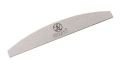
- Crescent shapes—they have one straight side and one rounded side.These files are a combination of a straight file and a banana file.
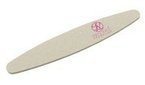
- An ellipse is a symmetrically rounded shape.Unlike banana-shaped files, you can rotate it in any direction to use its entire abrasive surface.You can trim your nails, shape them, and file them around the cuticles as you like.It's very comfortable.
- Block – a spongy paper cube for matting and smoothing out minor imperfections.Useful for any nail extension technique.
Glass files.
These files aren't exactly cheap, but they do have a long service life.Some manufacturers even offer a lifetime warranty on their nail files.For this to happen, glass of the appropriate quality must be tempered at least three or four times.To create a textured surface, 2-mm-thick glass can be etched with acids or sandblasted with corundum..This last method is the most durable.
Glass files can be cleaned with a brush under running water, disinfected, and sterilized.
You can use a glass nail file for traditional manicures and pedicures.Even when treating thin nails, there is no risk of splitting, and they rarely cause damage to the nail plate.Nail technicians use them for gentle shaping of nail tips, acrylic nails, and gel nails.It's best to dip the nail file in water for a moment before using it—it provides better grip, cools the material, and files more effectively. A fine-grit glass nail file properly smooths the free edge of the nail and the nail plates, making them smoother and less brittle.They're every woman's favorite tool.Files with an even abrasive surface won't damage even polished nails.
However, they do have one drawback.If a good-quality glass nail file falls on a hard surface, it will shatter into tiny pieces, and all you can do is sweep them up and throw them in the trash..
Sapphire Files.
The "disc" file is made by cutting knurls to create an abrasive surface.Moleta is a slightly rough material, and like a glass file, it does not cause the nail plate to split..
Sandstone Files
It is a type of acid-etched stone.A very gentle nail file that also helps remove cuticles.
Silicon files
As the name suggests, they are made using silicon powder.
Teflon Files
A rare name that comes from the core used in the file.
Metal files.
This type of nail file isn't very popular among many manicurists.There are, however, some people who can't imagine their toolbox without this file.There is a myth that metal nail files cause the nail plate to split, create splinters, etc..Of course, sandpaper and other tools can do the same thing as well.If you use a nail file with the wrong grit, misjudge the condition of the nail plate, hold the file incorrectly, or press it too hard against the nail plate, you will certainly encounter the problems mentioned above..
Metal files are made by applying and welding tiny stainless steel filings to a stainless steel plate.Tiny filings are called "diamonds" because their edges are initially as sharp as diamonds; after thorough and precise processing, they become delicate while still fulfilling their intended purpose..
These are very durable, virtually indestructible nail files.They can be washed, disinfected, and sterilized.They're very thin (1 mm), flexible, and you can do practically anything with them.Fine-grit files are almost impossible to find these days; the only ones left are the ones that are most versatile—sizes 180 and 240.
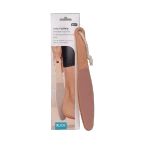
These files aren't the cheapest, but if you know how to use them properly, they'll quickly pay for themselves.You can use these nail files for manicures and pedicures, as well as for shaping nails using gel or acrylic techniques on artificial nails.Even thick and hard nails are no problem for this type of nail file.You can also use them to remove calluses from your heels.It all depends on your skills and your approach to working with them.
insert
As you can see from the descriptions above, there are many conclusions you can draw.Everyone knows that there are cheaper and more expensive nail files; they're similar but vary in quality, and come in different shapes, colors, and sizes..You are a reputable nail technician and pedicurist—podiatrist.Don't just take any job.A good tool in the right hands is half the battle.Try one nail file first before you buy more.It's up to you to decide which file works best, lasts the longest, is the most effective, is the fastest, and is the most precise..
There are probably still some topics related to nail files that haven't been covered in this article, but if this information has expanded your knowledge even a little, we're very happy about that.
If you'd like to add something on this or any other topic, please contact us.We can post your article on our website and credit it to you by your first and last name.Go ahead—share your experiences with others.
We hope you make a good choice.
Read more: