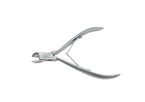
How can you keep your tools and cutters in perfect condition?

Cynics will say it's best not to unpack them at all, not to use them at all—just put them in a drawer and leave them there...
To their surprise, it didn't work out.All tools and cutters are made of various steel alloys.Their compounds react to their environment, and after a fairly long period of inactivity, surprising reactions occur.But that's not what we're going to talk about here this time.
Metal tools such as nippers, pliers, chisels, probes, hoof knives, and cutters should not only serve for a long time in the dental office, but also serve as a symbol of quality and professionalism in the hands of a specialist and a sign of safety in the eyes of the client or patient..
Unfortunately, not everyone has properly cleaned, disinfected, and sterilized nail clippers and drill bits in their office.
Below are photos of a dozen or so tools that have been severely neglected by their owner.
The pliers show rusty and baked-on deposits, and the cutters show a change in the metal's color, likely caused by the aggressive effects of the chemicals used or by failure to observe the recommended processing times for the products.The cleaning, disinfection, or sterilization procedures for the tools (from six different companies) were likely grossly violated.This resulted not only in visible contamination but also in damage to and dulling of the precision blades.
The following photos show a comparison of worn-out drill bits with a new drill bit (in its packaging), as well as neglected nail clippers and identical clippers that were similarly worn but were cleaned only with RUCK Ultraschallreiniger and disinfected in an ultrasonic cleaner using RUCK Instrumentendesinfektion..
Below the photos, as a warning to other users of professional tools, we list the reasons for such or similar oversights.
(Click on the photo to enlarge it)
|


|

|

| 
|

|

|

| 
|

| 
|

|
- Probably a lack of time to properly clean, disinfect, and maintain the instruments,
- a lack of staff to ensure compliance with procedures for proper cleaning, disinfection, and sterilization,
- failing to read the information on the labels of cleaning, washing, and disinfecting products,
- no Polish translations on the liquids used,
- treating fluids from different manufacturers in the same way, i.e., using the same proportions and times,
- the use of uncertified products,
- a lack of knowledge about proper disinfection and sterilization,
- using inappropriate, ineffective, or defective equipment for disinfection (e.g., an ultrasonic cleaner) and sterilization (autoclave),
- failure to comply with the disinfection times specified by the product manufacturer,
- the use of products that are too harsh,
- an incorrect ratio of the mixture of concentrate and water, or of powders and activator,
- using expired products or disinfecting instruments with expired disinfectant,
- cleaning and disinfection procedures performed too late after the procedure was completed,
- lack of adequate inspection of tools for wear or contamination,
- washing clean tools together with tools that have deposits or rust on their surfaces,
- using hot water instead of cold water to dilute concentrates,
- Disinfecting items in ultrasonic cleaners using lukewarm or heated liquid (disinfecting one item at a time); in addition to ultrasonic waves, these cleaners also generate heat,
- rinsing under running water that contains too much calcium and/or salt,
- cleaning and disinfecting non-disassembled instruments,
- failure to dry the tools properly,
- lack of regular maintenance of the shears (lubricating them with the appropriate oil),
- failure to properly separate tools from one another, i.e., placing tools in washers or tubs so that they touch or are stacked on top of one another,
- failure to remove air bubbles from metal tools before turning on the ultrasonic cleaner,
- there is not enough liquid in the basin or sink to cover the instruments being disinfected,
- too much liquid in the ultrasonic cleaner (above the max level),
- packaging damp instruments in bags or sterilization sleeves,
- selecting an inappropriate autoclave program for sterilization,
- No authorized service provider for equipment used for disinfection or sterilization.
Our Podiatry Guide contains a wealth of valuable information on cleaning, disinfecting, and sterilizing instruments and burs.
 These schematic tables explain how to use and dilute disinfectant concentrates.
Table of Times and Instructions for Preparing Instrument Disinfectant Solutions
 A schematic table showing the sequence of steps performed during the disinfection and sterilization of instruments.
Disinfection and Sterilization of RUCK® Instruments
 A schematic table showing the sequence of steps performed during the disinfection and sterilization of drill bits.
Disinfection and Sterilization of BUSCH® Drills
 Characteristics of RUCK® Disinfectants
Spectrum and Duration of Action of RUCK® Disinfectants
All the files are in color, and anyone can save them to their computer or print them out.You get this information from us for free!!!
May this article enrich the knowledge of those who have already realized their lack of knowledge and those whose knowledge on this subject is too limited.
Let's take good care of our tools and cutters—they deserve it!
02.11.2016
Author of the article:
Marek Musioł – Business Development Manager
Lady's Nails Cosmetics
I also invite you to read the article "Where does rust on stainless steel tools or cutters come from??"