How can you tell if a podiatrist is good?

How can you tell if a podiatrist is good??
Take a moment to think and decide which of the following answers is correct?
- based on how the patient is spoken to
- on the smooth skin of his patient's heels
- by the number of diplomas and certificates
- after his patient's nails had been properly trimmed
- based on the equipment he uses
- along the nail fold of his patient
- based on the number of procedures she performs
- after completing training in toenail reconstruction and prosthetics
- based on the number of friends on Facebook

Almost all of the items listed above are very important, but according to the most experienced podiatry specialists, only one of them is the most important.
If it were a matter of how to talk to a patient, , one could say that qualities such as politeness, composure, courtesy, and the ability to give instructions and guidance to both children and the elderly have a significant impact on success in patient interactions.
All of these qualities are very important, but they are not the most important factor in determining whether a specialist is a good podiatrist.
The number of diplomas and certificates displayed on the office walls indicates prestige and recognition among clients/patients and colleagues.This is very important.
Knowledge acquired and attested by a certificate or diploma deserves recognition and respect.However, it is not a measure of expertise, and it does not prove that someone who holds certificates and diplomas is definitely a good podiatrist.
About the equipment he uses for treatments.
Professional equipment in a podiatry office plays a significant role.It helps ensure that the procedure is performed correctly, quickly, and painlessly.It improves the podiatrist’s working conditions and the comfort of their patients.
Using top-quality tools, milling machines, and chairs does not necessarily mean that a podiatrist is among the best in the field..
Given the number of procedures she performs.
If many people come to a podiatry office seeking a service or treatment, it means the office is busy and there is a lot of interest in it.It may also indicate that there is a great need for podiatric services and treatments in a given area of operation.It may also be the result of a lack of competition in a given city where, for example, there is only one clinic offering foot treatments.
Just because a clinic performs a large number of procedures doesn't mean it has a good podiatrist on staff.
Based on the number of friends on Facebook.
It's good to have a lot of friends on Facebook, because it's a very popular way to communicate.Facebook is also used to share information and announcements with customers who are friends.
You meet lots of people, read interesting facts about podiatry, and share professional experiences.Active participation in all kinds of discussion forums is a very positive thing because it helps promote podiatry.
Gaining recognition and popularity through increased participation in discussions and the number of friends on Facebook in no way enhances a podiatrist’s standing, much less makes him or her a good podiatrist.
On the smooth skin of his patient's heels.
Smooth skin on the heels is something customers really appreciate.A specialized pedicure performed by a podiatrist is highly valued by patients with cracked heels or thick, calloused skin.Feet free of calluses, corns, or warts often pose a major challenge even for a podiatrist.
Although restoring the skin on the feet to a healthy state after the medical conditions listed above requires specialized knowledge, the ability to use a variety of tools, and expensive equipment, these tasks alone do not qualify someone to be considered a good podiatrist.
A specialist who knows how to trim toenails properly.
Cutting dystrophic, ingrown, thick, thin, and brittle nails is not nearly as simple as some people might think.Specialized toenail clippers and podiatric drills are often needed for trimming toenails.Knowledge in this area has a direct impact on the quality of this service and on the patient’s ability to walk normally in their shoes after the procedure.
Performing nail reconstruction and even prosthetics is a major challenge for many podiatrists.
The accuracy and precision involved in crafting a nail plate prosthesis are a true testament to craftsmanship.The results of this work are appreciated above all by many patients with nail defects.In this extremely difficult technique, all requirements regarding the preparation of the nail, the nail bed, and the nail shaft must be met.
Possessing skills in toenail reconstruction and prosthetics qualifies a specialist to be placed at the highest level in podiatry.
Despite this, according to many professional podiatry experts, these skills alone are not enough to qualify him as a good podiatrist.
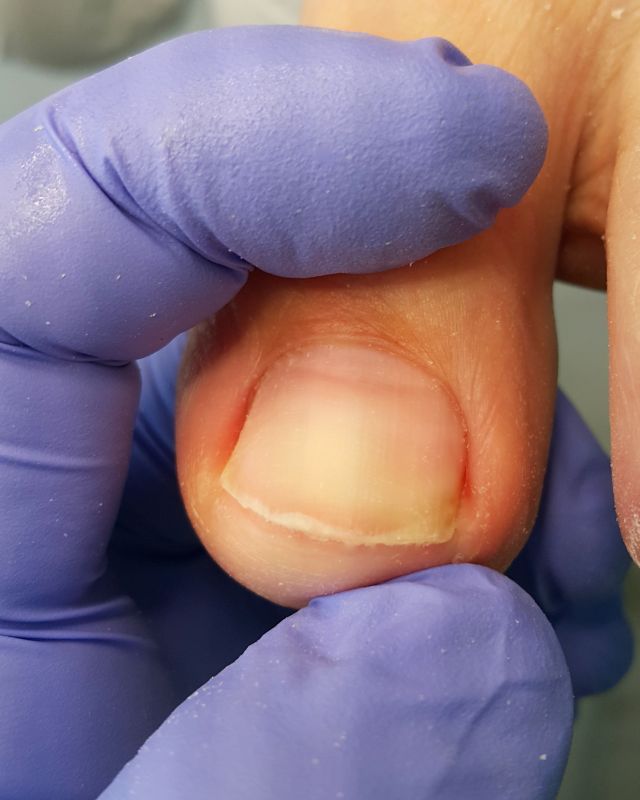
You can tell a good podiatrist by the nail beds of his or her patients.
A healthy, clean, and properly shaped nail bed is a hallmark of a podiatrist’s high level of professionalism—according to prominent and well-known figures in the field of podiatry.
Why?
The nail bed is a special part of the foot.
Abnormalities related to walking most often occur within the nail fold.These primarily include ingrown toenails and ingrown fingernails, as well as the inflammation caused by these conditions and the resulting deformities.
Conducting proper, non-aggressive podiatric treatments related to nail correction—and thus the application of orthonyxial braces—requires prior, very thorough cleaning of the nail shaft and the natural nail plate.
A strong and healthy nail bed, free of calluses and bacteria-harboring subungual crevices, results in beautiful, healthy nails that grow properly.
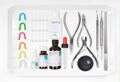
To ensure this, the podiatrist performs very precise procedures.To do this, he uses specialized chisels, probes, burs, tampons, specialized tinctures and creams, gel compounds, and orthonyxial clips.The near-perfect preparation of the nail beds is essential in nail reconstruction and prosthetics.
Thus, the nail bed serves as a podiatrist’s calling card and a reflection of their skills.
"Show me your patient's nail bed, and I'll tell you if you're a good podiatrist"—that's what one is tempted to say.

Photo.1.While working with a podiatry chisel—a man's toe.
Photo.2.Cleaned nail beds—a woman's finger.
Author: Marek Cyrulik
Article added.09.2015
This article is based on a wealth of information gathered, as well as interviews and discussions held during podiatry exhibitions, trade shows, conferences, and seminars in Germany.