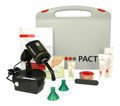
PACT® Photodynamic Therapy for Nail Fungus


20% of the human population has a fungal infection.One in five adults under the age of 65 and one in two adults over the age of 65 has a nail fungus.
Nail polish, conditioners, and creams cannot treat nail fungus.Fortunately, there is now a solution for many people struggling with this unpleasant condition.PACT® solves these problems.
Thanks to PACT® therapy, podiatry practices and dermatology clinics can already achieve success.
Photodynamic therapies have been known since the early 1990s.They are effectively used in the treatment of cancer, in fighting infections, and in treating skin diseases.The combination of a colored gel that reacts to a special LED light has opened the door wide to a field of medicine focused on treating so-called "difficult cases".Professor Rainer Hahn, Ph.D., and Dr..Frank Schynowski and his team are the creators of PACT® technology, developed to treat nail fungus as well as open ulcers and wounds.
Prof.Dr. Rainer Hahn is a researcher who studies the effects of light on bacteria, viruses, germs, and fungi.Dr. Frank Schynowski is a distinguished chemist specializing in the application of materials in the technology of photodynamic light transfer and light-induced reactions in bacteria, viruses, pathogens, and fungi.
They worked on their idea for many years until they finally achieved unprecedented success.Photodynamic therapies are performed based on their ideas and experience, and using equipment they invented, in many clinics and podiatry practices across Western Europe.The therapy's nearly 100 percent effectiveness has been confirmed by many years of research, testing, and specific case studies.Effective PACT® treatments number in the thousands.That is why these people and their technology can be fully trusted.
|

 |  |
Diagnosing Nail Fungus The symptoms of nail fungus are very characteristic, and in most cases, a visual diagnosis is sufficient.However, not every change in the appearance of a nail indicates a fungal infection.There are many symptoms similar to those of a fungal nail infection.For example, psoriatic nail disease, which is often mistaken for a fungal nail infection.Common or similar symptoms include a yellow, brown, or gray discoloration of the nail plate.Especially in more severe cases where the disease is at an advanced stage, an appropriate mycological examination should be performed.In such cases, a sample is taken from the nail and sent for laboratory testing to confirm or rule out a fungal infection.In the laboratory, fungi are cultured and identified. Intended Use of the PACT® MED Lamp and PACT® NagelpilzGel PACT® NagelpilzGel was developed for the antifungal treatment of fingernails and toenails. |
How PACT® Therapy Works? |
 |  |
Photosensitizers contained in a special blue gel stimulate microorganisms, bacteria, and fungi to become more active.During irradiation with the PACT® MED lamp, LED radiation of a specific wavelength is emitted. During a brief 9.5-minute session, the fungi are destroyed.The more advanced the fungal infection is, the more frequently the radiation treatment should be performed. The treatments are painless and harmless. |
How to Use Fungi are less sensitive than bacteria, which is why it is sometimes more difficult to eliminate fungi in hard-to-reach areas of the nail.Photodynamic, antibacterial therapy makes it possible to destroy fungi in as little as a single session or a weekly session. Treatment for severe nail fungus. Twice a day (they can be back-to-back sessions) for several days.Before applying the gel, clean, remove, or file away any diseased or thickened parts of the nail and lightly buff the nail plate. End of the procedure The effectiveness of the therapy can be assessed after about.In 3 months, when the new nail will be visible.If the affected nail does not regrow or if the nail plate continues to spread toward the nail folds, the procedure should be repeated or the treatment extended. |
|


See examples of nails treated with PACT® (PDF file)
How to Effectively Get Rid of Nail Fungus (PDF)