The History of Ortonyxia


Orthonyxia is a field that deals with the correction of ingrown fingernails and toenails.Most cases involving this type of nail occur on the feet.That is why orthonyxia is used primarily in podiatry.
The name itself comes from the Greek word ORTHONYX—ORTHO = straightening, NYX = nails
Before the first methods for straightening or bending nails were developed, the only options available were surgical procedures, chiseling, and filing the nails.
The first person to use a spring-wire lever was Edward E..Stedman, who lives in Ohio, USA.His idea was patented in 1873.The wire clip resembled the letter M. It had what are known as "double prongs," resembling two elongated omegas, and the ends of the prongs were hooked under the fingernail.
In 1938 in England, Rosenstein used a strong surgical thread threaded through two holes made in the fingernail, and then pulled it tight and tied it.That's how he caused his ingrown and curled toenails.
In 1946, Scholl used silver spring wire.The diameter of this fairly soft wire is 0.4 mm.There were three different sizes available.Activation occurred through what is known as a double bond.
1948: Greppmayr from West Germany uses the Guttapercha technique.The rubber-like sticks, when heated, filled the underside of the nail; they were designed to support and guide the sides of the nail into the correct position. They also served as a prosthesis and a replacement for the excised portion of the ingrown toenail.
In 1950, Greppmayr patented a technique for casting dentures.
In 1953, Södergard, who was living in Denmark, used a 2-centimeter-wide strip that was attached to the underside of the nail, stretched tight, and glued in the center of the nail plate.
In 1955, the Scotsman Fraser began using Sulci tubes.
The cut Sulci tubes are slipped under the edges of the nails and act as a barrier to prevent ingrown nails.
Then, in 1960, in Texas, the first three-part wire clip was invented by Gifford.It had two sections on the side and a 0.15 mm flat loop for tying.At that time, Gifford used wire that was 0.4 mm thick.
1960.In Scotland, Ross Fraser used the twisted-wire method.According to the available information, it was a sort of mesh that was folded under the nail on one side and adhered to the upper part of the nail plate.The technique was named Ross Fraser I.This is the equivalent of today's Goldstadtspange strap when used as a single-sided buckle.
A year later, in 1961, thanks to the same man, a clip was invented that attaches on both sides of the fingernails.
Just as in today's spring-loaded, gold Goldstadtspange bands, Ross Fraser uses the so-called “W” bend to activate the nail-lifting mechanism.
In 1964, in the Netherlands, Waldmann unveiled a two-piece plastic clip.
That same year (1960), Waldmann also used chrome-plated corrugated wire.
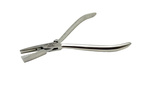
Rading – Sweden – 1968.Special pliers are being developed to quickly make loops out of wire.To this day, his pliers—which are used to make the omega-shaped loop in Fraser clasps—are still well known..Even back then, using these pliers it was possible to bend wire with a thickness ranging from 0.3 to even 0.7 mm.
In 1969, Kitzka of West Germany began supplying Fraser buckles in sizes ranging from 11 to 25 mm.At that time, he used 0.5 mm thick wire.
Eight years later, in 1977 in Austria, a man named Gorkiewicz used a thin wire 0.2 mm thick and 0.4 mm wide.The thin wire in question was a very high-quality spring wire that, once activated, pulled the nail plate upward.Today, an improved clip (shape-memory wire) called Orthese® Austria is still in use.
1982 – In Germany, Erkodent uses the ERKI technique.It involves attaching two plastic hooks to the sides of the nails and connecting them with a rubber ring.In this clip, the tension of the rubber band activated the hooks, which in turn pulled the nails upward.
1987 – Bernd Stolz, West Germany – BS-Spange plastic clasps are introduced to the market.Clips ranging in size from 14 to 24 mm are glued to the nail plate, which has been matted beforehand.A specially formulated plastic blend makes the strip flexible and allows it to lift the side edges of the nails.
1988 – Switzerland – Glor used a gold wire that served as a one-sided clamp.The pure gold wire was round on one end and flattened at the point where it was attached (glued).The elasticity of the gold wire, once secured, pulled the nails upward.
In 1988, the three-part VHO Osthold (Virtuose Human Orthonyxie) wire clips were developed.Elvira Osthold invented hair clips.
The brace can be used for an extended period of time and at various stages of nail disease.The wire is made of stainless steel, specially shaped, and 0.4 mm thick.Connectors made of thinner 0.3 mm wire.Turning the fastener vertically with a special hook activates the latch.
Following the example of the VHO Osthold clips, the 3TO wire clips were developed in 2002.The front buckle and slightly modified design set these buckles apart from VHO buckles.In addition, the wire thickness is 0.45 mm, and for connectors, it is 0.35 mm.
In 1990, Erkodent in Germany introduced a flat bracket made of spring steel coated with plastic.Here are today's strips Onyclip, which can be used as either a single-sided or double-sided clip.
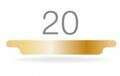
That same year, in 1990, the gold-plated buckle was created through a collaboration between podiatry pioneer Hellmut Ruck Sr. and his son-in-law, Wolfgang Knörzer Goldstadtspangewas created. The spring-loaded strap, 8 mm wide.3 mm.It can be used as a single-sided or double-sided clip, as well as a surface clip that is glued to the nail plate.A "memory" clasp is hypoallergenic because it is plated with pure gold.
The year 2002 brings minor changes to the VHO Osthold clamps.The sizes range from 9, and the wire thicknesses are 0.3 mm and 0.4 mm.
In 2006 in Kassel (Germany), Brigitte Rathenow exhibited the ORA clasp.The two-piece, single- and double-sided clamp is made of stainless steel wire.To attach the clip, carefully trim the curved wires, bend them, and hook them onto the sides of the nail; on the upper part of the nail plate, overlap the two parts..Once they are in place, the brace is designed to support the nail plate and guide its regrowth along the correct path.
In the fall of 2007, the German company 3TO GmbH launched Podofix.
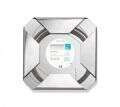
The manufacturer has placed a stainless steel wire, bent to the proper shape, inside a special plastic plate.The plastic-and-wire clips, currently available in three sizes, are glued to the nails, and the protruding wire loop is tightened using a metal wrench.Turning it activates the sides of the plastic plate, thereby straightening a crooked nail..
In 2008 and 2010, the same company, 3TO GmbH, tested a new clamp COMBIped. In the spring of 2010, following successful testing, it was officially launched on the podiatry market.
COMBIped is a simple, stainless steel, chrome-nickel wire, with one end—which has a hook—molded into a tiny yet sturdy piece of plastic.The other end of the spring wire is cut to the appropriate length, and then a tiny hook is bent at that end.
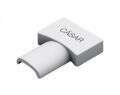
The COMBIped clip is easy to use: simply place the hook under the nail plate and attach it (without stretching) in the correct spot on the nail.COMBIped clips come in three "memory" settings, each of which differs in wire thickness.Clips are used for both ingrown toenails and nails that curl under.
In February 2014, a Polish woman with a master's degree in engineering.Aneta Oleszek launched a belt buckle called "Podoklamra".
The subclasp is made of dental implant steel.It has two arms made of hard steel wire in various diameters—0.3 mm, 0.4 mm, and 0.5 mm—and a connector made of soft steel wire in the following diameters: 0.3 mm, 0.4 mm, 0.5 mm, made of soft steel (more malleable).Podoklamra is universal, which means that a single Podoklamra model can be adapted to any nail shape and size without the need for alterations; therefore, Podoklamra does not come in different sizes.
On May 16, 2015, at the COSMETICA trade show in Stuttgart, Germany, the new RUCK® ORTOGRIP professional and RUCK® GOLDSTADT professional orthonyxial clips were unveiled.al.
Well-known figures are behind the introduction of these braces: Elvira Osthold, Wolfgang Knörzer, Hellmut Ruck, and Simeon Ruck.
RUCK® ORTOGRIP professional clamps are three-piece wire clamps available in six sizes.Their side profiles allow for painless and quick application on any type of toenail.The colorful handles make it easy to quickly find the size you want.
RUCK® GOLDSTADT professional staples are available in two thicknesses: 0.10 mm (classic spring memory) and 0.15 mm (stronger spring memory).In addition, they are divided into three shapes: full-size (applied on both sides), half-size (applied on one side), and strips (adhered to the nails).
Thanks to the addition of gold strips in various sizes, the buckle is entirely gold-plated.
The History of Orthonyxia probably does not include all inventions.Some may have been omitted due to a lack of supporting documentation, or they may simply not have been included because they didn't work out..
Many techniques and materials invented long ago continue to be modernized and improved by the successors of those inventions.
Every inventor who is considering bringing a new product to market naturally wants to achieve success in the form of financial gain, but above all, they work for the benefit of patients and to achieve the best possible therapeutic outcomes.That's good, because thanks to people like that, we're seeing progress in podiatry.
It is also worth noting that our compatriots are joining the ranks of the world's elite inventors.Polish Podiatry certainly has great ambitions to become a major player on the global stage when it comes to advances in podiatry.That's something to be happy about.
Latest News
Recently, there has been a noticeable demand for innovative ideas related to orthonyxia in podiatry.
For example, the Japanese invented the Aid clip, a prototype of which was showcased at the trade show in Düsseldorf in 2011.The clip is intended for ingrown toenails.Whether it will gain recognition in the podiatry community, however, remains to be seen.For now, there's been no word from her.
Special levers for ingrown toenails are also appearing in the Far East.The structures don't look complicated at all.If the price is reasonable, there will certainly be buyers.
However, it's not enough to just come up with an idea to be successful.Every product must be thoroughly tested and inspected, and only after extensive testing is the concept submitted to the relevant authorities and put into practice—that is, in podiatry clinics..
Podiatry is evolving and with it, orthonyxia as well.This is evident from the collected data.
It is worth noting here that some techniques and materials have their supporters, while others have their opponents.Well, it's always been that way, it is that way now, and it will probably always be that way.The most important thing is that the world is evolving.It is also advancing thanks to the inventors mentioned above, but also thanks to all of us—podiatrists, trainers, lecturers, and their students.
Let's work together to advance podiatry in Poland.Let's share our insights and information.Let us serve one another.Let's just move forward!
Marek Cyrulik
Text added18.11.2014
Last updated17.05.2015
This article was written using information obtained from publicly available sources, such as books, the Internet, and discussions held during various meetings among individuals involved in podiatry in Poland and abroad..
Would you like to see some of the orthonyxial braces described in this article??Go to Types of orthonyxial braces (link)