Ergonomic Guidelines for Podiatrists

Who, where, and which school teaches workplace ergonomics to specialists in.podiatry?Or maybe it's not a very interesting topic?
Dear reader, if your answer to the second question is “yes,” then in this short article I will try to change your mind on this subject.
As long as you're young, poor posture while working may not bother you right away, but over time, pain can strike quite suddenly, seemingly for no reason.One thing you can be sure of—your spine, muscles, and brain will remember all your past posture problems, and sooner or later they’ll make themselves known with double the intensity.If you're looking for an answer to the question of why your arm or back is hurting right now, keep these tips in mind.
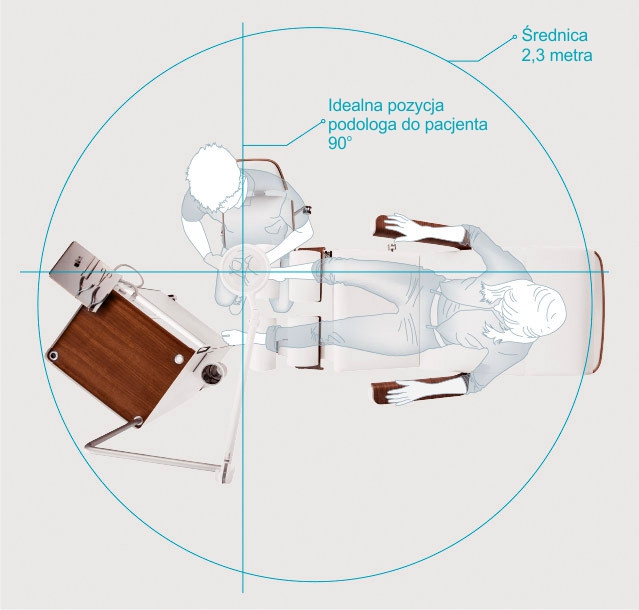
Nail-Cutting Position feet.
Don't trim your toenails while lying on your front. Do not lean forward.In these positions, your muscles and cervical spine suffer.
Always trim your nails from the side or the back-side.. This way, you not only have perfect posture, but you can also see your nails.You can trim them by starting at one end of the tile and finishing at the other, or by starting in the middle of the tile and finishing at each end.
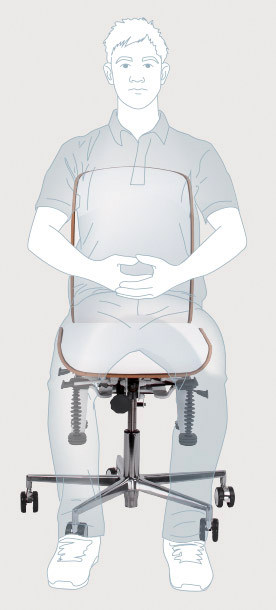
Adjust the chair to the nail-trimming position.
| How to do this in a seated position? If you are right-handed and are holding the nail clippers in your right hand, sit in a chair and position yourself to the patient's right—that is, start trimming the nails on their right foot. | |
|
How to Trim Your Nails While Standing? | |
|
|
Do not twist your hand or wrist while cutting your nails. Turning the hand outward causes stiffness in the shoulder, forearm, and wrist.This usually happens when working in the forward position. |

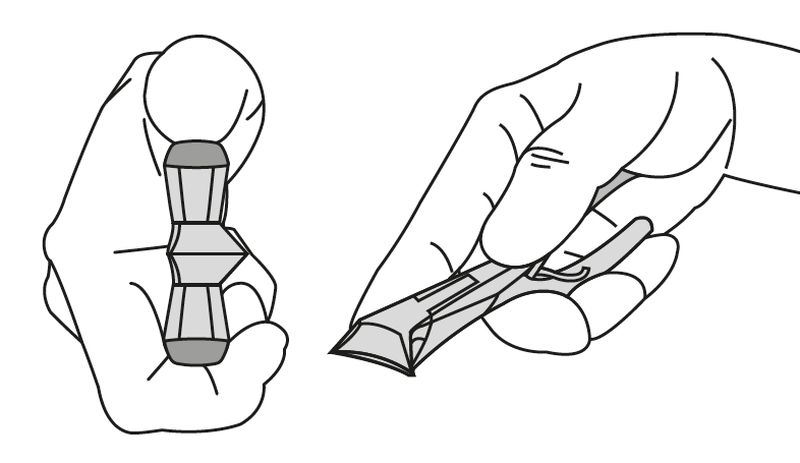
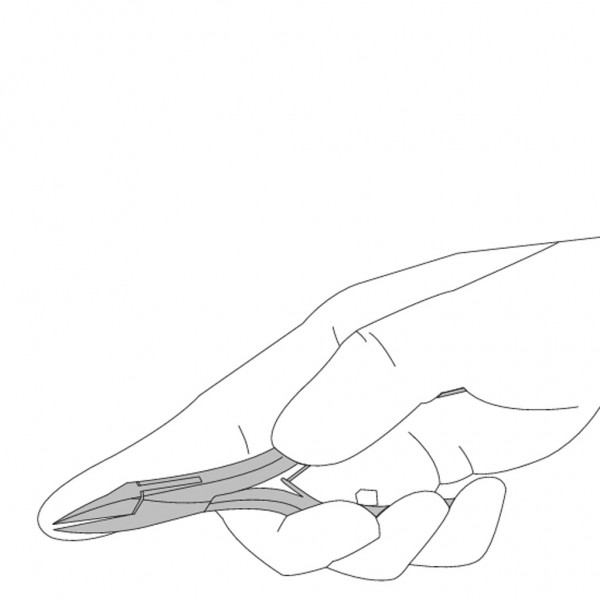
Select the size of the nippers.
Sometimes a patient has thicker nails, and the pressure from gripping the nail clippers while cutting can put too much strain on the hand muscles.
To avoid this, you need to know how to choose the right clippers for the job.It's not just about the shape of the blade, but above all about the size and shape of the handles.The best sizes are 11.5 cm and 13 cm.The handles of the nippers should be trapezoidal in shape, because this shape fits perfectly with the anatomical shape of bent fingers.Contrary to popular belief, grooved handles do not actually provide more resistance when squeezing the pliers; on the contrary, they have a smaller surface area that fits snugly against the hand muscles..It is the smooth surface that fits better in the hand, and success when cutting nails also depends on the strength of the hand muscles and, of course, the blade of the clippers.
Good-quality nail clippers have strong and flexible springs.Adjusting the pliers and making them “move” smoothly involves bending or unbending the springs appropriately.The manufacturer of the pruning shears adjusts the springs to the optimal setting, but he doesn't know whether his shears will end up in a small, delicate hand or a large, strong one.Any owner of a good pair of nippers can adjust the clamping force to suit their own needs.

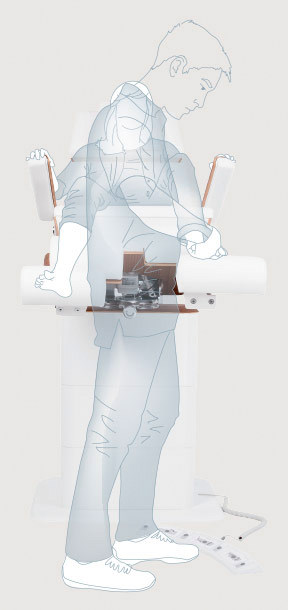
Sitting Position During Foot Sole Treatments. |
|
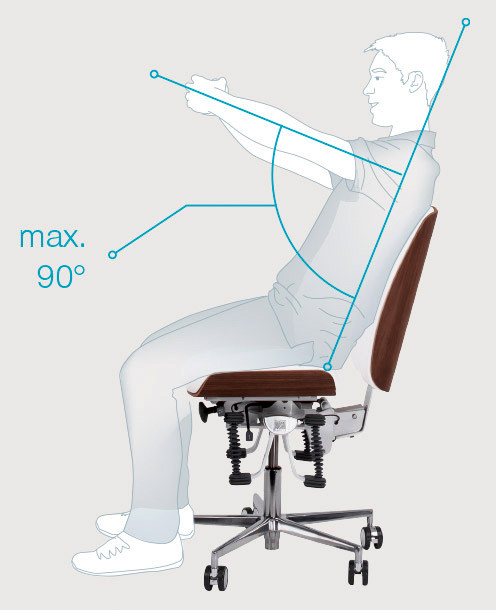
|
Standing Position During Procedures on the Soles of the Feet. |

And how can we work ergonomically when our patient is a child, an obese person who can’t turn their foot, or if a very tall patient comes into the office whose calves reach the end of the last cushion on the footrest??
No problem at all.The RUCK Podolog Stella and Podolog MOON chairs feature adjustable calf pads, where the little patient can rest their little foot.And an extra flat pillow is placed behind his back to provide comfortable support.When treating young patients, it is best to raise the dental chair and work while standing.
For tall patients the footrests can be extended to their maximum length.A flat cushion is placed between the armchair cushions, and on top of that goes a movable cushion, which in turn comes in two different heights.Work on the soles of the feet in tall patients should be performed while standing.In addition, it may help to adjust the seat to a reclined position.
Obese patients have trouble moving around, so they may also have difficulty sitting in a chair.Thick thighs may restrict a patient's ability to sit, which may lead to attempts to reposition the foot from an uncomfortable position to another.For these patients, it is necessary to move the round footrests outward.However, the idea here is not to rotate the entire footrest outward—because that would place it at an inappropriate angle to the foot—but rather to move the footrest itself sideways, perpendicular to the chair..
|
The option to adjust or remove the footrests on certain chairs is completely unnecessary and has no practical application in podiatry or pedicure treatments..Some people say that extending the armrests outward makes it easier to sit down in the chair.That’s not true—the patient does not sit down or stand up from the front of the chair, where skin scrapings or other remnants from the procedure are most often still present, but rather sits down and stands up from the side of the chair.Besides, if the chair doesn't have fold-down armrests, all you have to do is lower the armrests, and the chair will swivel to the side. |
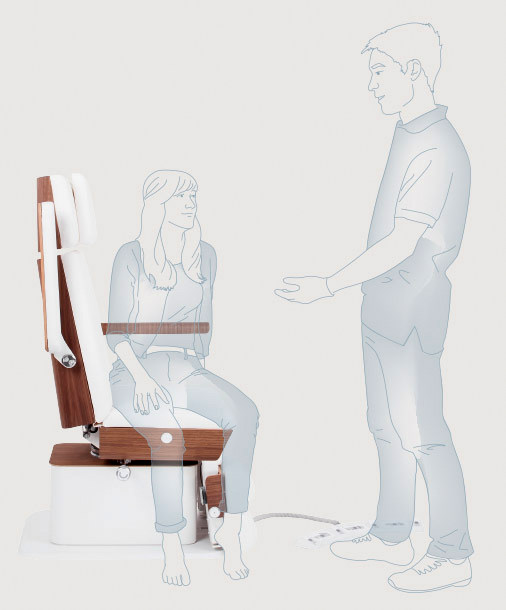
Below are a few photos illustrating other tasks and workplace ergonomics.

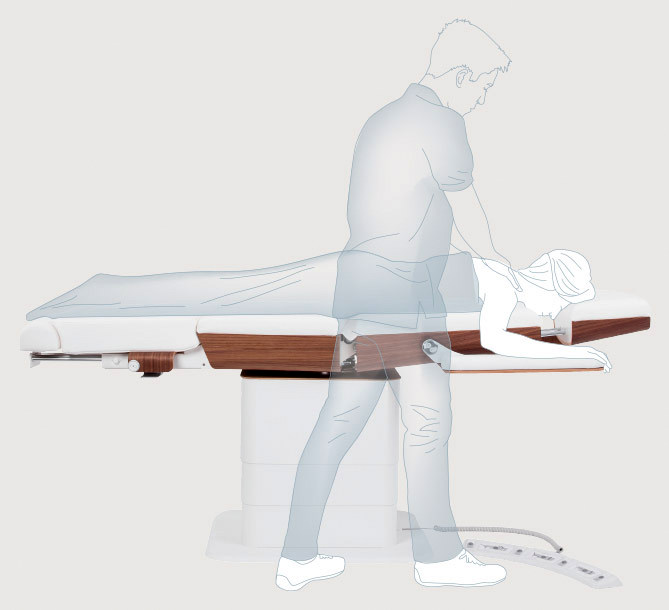

Next question:
What ergonomic postures should a podiatrist who provides mobile services adopt??
Such a specialist must be able to work in a variety of settings—both in hospitals and at home.There isn't a great podiatry chair or a Bioswing chair available...
What should a specialist do when, at the home of an obese patient who can barely walk and is unable to lift their leg, they need to perform a procedure on the patient’s toenails or heels??
In such cases, is it even possible to maintain an ergonomic posture while working??
Where in the patient's home should the procedures be performed—in the bedroom, on the sofa, in the bathroom, or, for example, in the kitchen??
How to Set Up an Ergonomic Workspace in Challenging Home Conditions?
It m.in.That's what they teach at RUCK® in Germany.
The study of workplace ergonomics is a required course at the RUCK® podiatry school.
Lectures and training sessions on workplace ergonomics are held.It was there, in Germany, at RUCK®, that I learned the ins and outs of workplace ergonomics for podiatrists.I must admit that I've been amazed more than once while watching a demonstration of proper posture during a podiatrist's work.
Workplace ergonomics is closely related to the equipment a podiatrist uses. RUCK incorporates design features that improve workplace ergonomics into the production of podiatry chairs, health chairs, cabinets, podiatry milling machines, and tools used by podiatry specialists.
Both the design concepts and the materials used, the appropriate shapes, the power of the motors in the chairs, the chair’s construction, and even the Podolog Nova 3 milling machine’s ability to absorb harmful dust, or the ergonomic tool handles—all have a significant impact on ergonomics, the podiatrist’s comfort, and the speed and effectiveness of work during podiatric procedures.
All RUCK® office equipment and furniture undergo extensive planning and testing before they are manufactured.They must be approved by podiatrists themselves before they are made available for sale.
Ergonomics and equipment have always gone hand in hand. That is why any self-respecting podiatry specialist should think first and foremost about themselves—their health and the right equipment they want to use for a long time.
RUCK is reaching out to you, too!You'll offer her your hand?
Marek Cyrulik – Lady's Nails Cosmetics